AI for Fracture Detection in X-Rays: Triage and Case Prioritization
Optimize your B2B strategy with advanced technical SEO and content marketing techniques to improve your visibility on Google.
AI in Radiology: Optimizing Fracture Triage for Faster, More Efficient Care
In today’s fast-paced radiology environment, the ability to detect fractures on X-rays quickly and accurately is essential for effective patient triage and prioritization. Delays in image interpretation can postpone diagnosis and treatment, directly affecting patient outcomes.
Artificial Intelligence (AI) has emerged as a powerful tool to streamline this process by accelerating fracture detection, improving diagnostic accuracy, and optimizing clinical workflows across imaging departments.
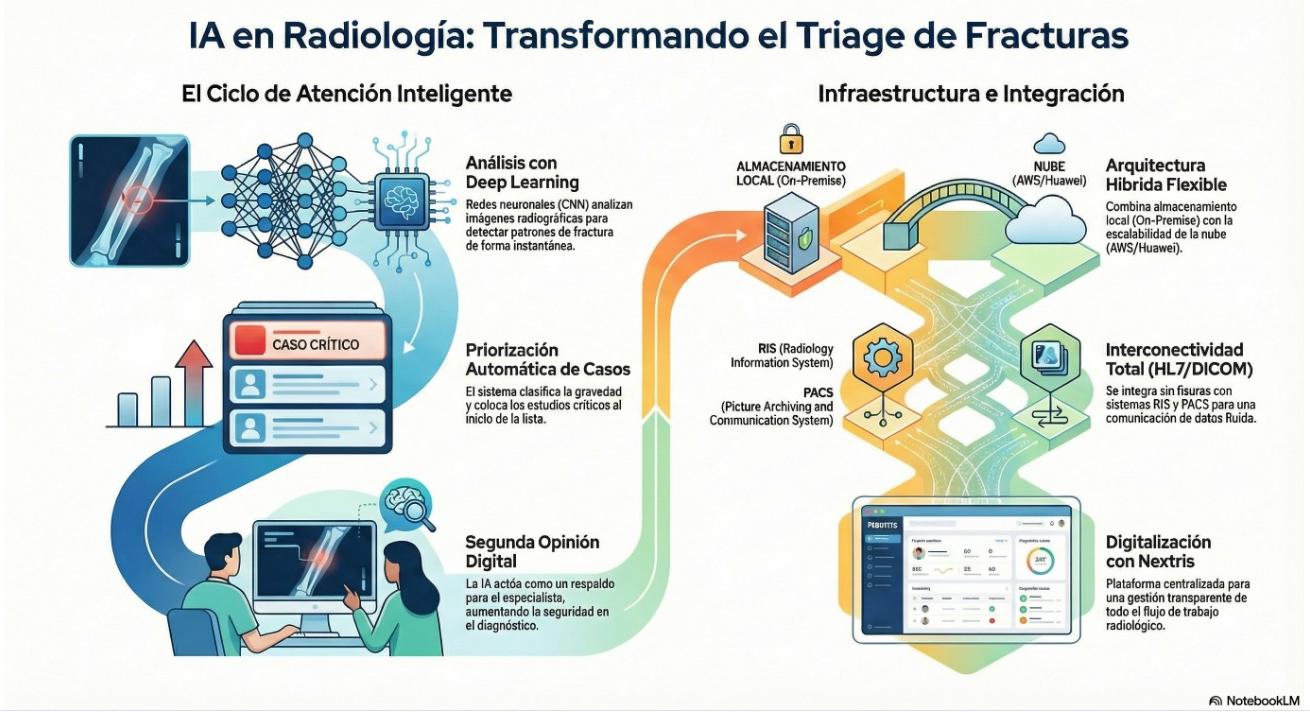
The Challenge: Balancing Speed and Accuracy in Fracture Detection
Radiology departments face the ongoing challenge of interpreting large volumes of imaging studies without compromising diagnostic quality.
An AI system capable of automatically identifying and prioritizing suspected fractures enables radiologists to focus first on the most urgent cases, improving patient care while making more efficient use of clinical resources.
Soft in Health: A Comprehensive AI-Powered Solution
Soft in Health is helping transform fracture detection through an integrated solution that combines advanced healthcare IT infrastructure with specialized AI algorithms.
The objective is straightforward: create a smarter, faster, and more reliable fracture detection workflow.
Strategic AI Integration into the Radiology Workflow
At the core of the solution are deep learning algorithms trained to analyze radiographic images and identify imaging patterns associated with fractures.
Automated analysis accelerates case detection while serving as an additional decision-support tool for radiologists, enabling more effective prioritization of urgent studies.
The key to success lies in seamlessly integrating AI into the existing healthcare ecosystem without disrupting established workflows.
Flexible Infrastructure: On-Premises and Cloud
To ensure secure, scalable deployment, Soft in Health combines traditional on-premises infrastructure with modern cloud platforms such as AWS and Huawei Cloud.
This hybrid architecture allows healthcare organizations to scale computing resources according to demand while maintaining security, reliability, and regulatory compliance.
Optimizing RIS and PACS Systems
Efficient imaging workflows depend on seamless communication between Radiology Information Systems (RIS) and Picture Archiving and Communication Systems (PACS).
Soft in Health enhances these systems using healthcare interoperability standards such as HL7 and DICOM, ensuring efficient management of imaging studies, patient information, and AI-generated results.
These capabilities are delivered through the NEXtris platform, which enables transparent AI integration and significantly improves radiology workflow efficiency.
Technical Overview of the Implementation
Deploying AI for fracture triage requires the coordinated operation of several critical technical components.
Deep Learning Models
Modern fracture detection systems primarily rely on Convolutional Neural Networks (CNNs), which have become the industry standard for medical image analysis due to their ability to recognize complex imaging features with high accuracy.
Standards-Based Interoperability
AI solutions must integrate seamlessly into existing healthcare infrastructures.
Interoperability is achieved through international standards such as HL7 for healthcare messaging and DICOM for medical imaging, allowing imaging studies and patient information to flow securely across multiple clinical systems.
Intelligent Case Prioritization
AI does more than identify potential fractures.
Modern algorithms can automatically prioritize imaging studies according to the likelihood and severity of clinically significant findings, allowing radiologists to review the most urgent cases first and reducing turnaround times in emergency settings.
Conclusion: Smarter Clinical Decision-Making Through AI
The adoption of AI in radiology represents a significant advancement in both operational efficiency and patient care.
By combining automated fracture detection with robust healthcare IT infrastructure, Soft in Health enables healthcare organizations to improve integration between RIS, PACS, cloud platforms, and AI-powered decision support systems.
Integrating AI into daily radiology workflows helps healthcare providers optimize resources, accelerate diagnoses, and deliver more timely, accurate patient care in increasingly demanding clinical environments.
Key Takeaways
- AI accelerates fracture detection in X-ray examinations, improving patient triage and case prioritization.
- Successful implementations require seamless integration between AI, RIS, and PACS using healthcare standards such as HL7 and DICOM.
- Flexible infrastructure—including both on-premises and cloud deployments—is essential for scalability, performance, and security.
- Soft in Health’s integrated approach enhances diagnostic accuracy while significantly improving radiology department efficiency.