AI in Mammography: CAD vs. Deep Learning and False Positives
Solve complex technical SEO and B2B challenges with advanced solutions that optimize your online presence and improve business performance.
AI in Mammography: Navigating the Challenges of Deep Learning and False Positives
Early detection of breast cancer remains one of the most effective ways to improve patient survival and treatment outcomes. Artificial Intelligence (AI) has become a transformative technology in mammography analysis, enhancing radiologists’ ability to identify suspicious findings with greater speed and consistency.
However, implementing AI successfully is not without challenges. Healthcare organizations must understand the differences between traditional Computer-Aided Detection (CAD) systems and modern deep learning algorithms while addressing one of the industry’s most significant concerns: false positives.
The AI Dilemma in Mammography: CAD vs. Deep Learning
The evolution of AI in breast imaging has produced two primary technological approaches.
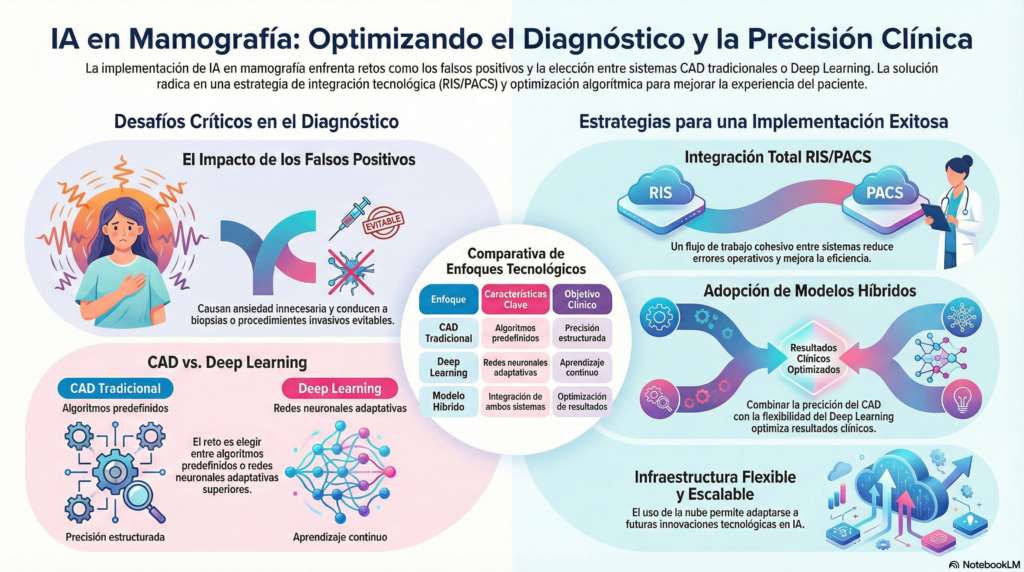
Traditional Computer-Aided Detection (CAD) systems rely on predefined algorithms and handcrafted rules to identify suspicious regions within mammograms. In contrast, deep learning uses neural networks capable of learning complex imaging patterns directly from large clinical datasets.
Although deep learning generally delivers superior diagnostic performance, selecting and integrating the appropriate technology remains a significant challenge for healthcare providers.
The Critical Challenge of False Positives
One of the primary obstacles in AI-assisted mammography is the occurrence of false-positive findings.
Incorrectly identifying healthy tissue as suspicious can generate unnecessary patient anxiety while leading to additional imaging studies, biopsies, and other invasive procedures that ultimately prove unnecessary.
For this reason, reducing false positives while maintaining high cancer detection sensitivity has become one of the most important performance metrics for modern AI solutions.
Strategies for Successful Implementation: An Integrated Approach
Successfully deploying AI requires much more than selecting the best algorithm. At Soft in Health, the focus is on integrating AI seamlessly into the healthcare imaging ecosystem to maximize both clinical and operational benefits.
Digitalization: The Essential First Step
AI systems depend on large volumes of high-quality medical imaging data.
Healthcare organizations must first establish a comprehensive digital imaging environment before AI can deliver meaningful clinical value. Digital transformation initiatives create the foundation upon which machine learning algorithms can perform accurately and consistently.
Systems Integration: The Key to Efficient Clinical Workflows
AI delivers the greatest value when it operates naturally within existing healthcare workflows.
Seamless integration between Radiology Information Systems (RIS) and Picture Archiving and Communication Systems (PACS) ensures that AI-generated findings become part of the normal diagnostic workflow rather than introducing additional manual processes.
Proper interoperability also reduces operational errors while allowing imaging studies, patient information, and AI results to move efficiently between clinical systems.
A Hybrid Approach: Combining the Best of CAD and Deep Learning
Rather than viewing CAD and deep learning as competing technologies, modern imaging platforms increasingly combine the strengths of both approaches.
Traditional CAD techniques remain valuable for standardized detection tasks, while deep learning provides greater adaptability and improved performance across diverse clinical scenarios.
Solutions such as NEXtris leverage hybrid AI strategies to optimize diagnostic accuracy in real-world clinical environments.
Continuous Algorithm Optimization to Reduce False Positives
Reducing false positives requires ongoing optimization.
Modern AI models continuously improve through retraining, validation against new clinical datasets, and refinement of detection thresholds. This iterative process improves diagnostic confidence while minimizing unnecessary follow-up procedures and reducing patient stress.
Conclusion: Key Considerations for Decision Makers
Successfully implementing AI in mammography involves far more than purchasing an AI application. Healthcare organizations achieve the greatest value through a comprehensive strategy focused on interoperability, workflow integration, and continuous optimization.
Key Takeaways
- Integration Over Isolation: AI delivers its greatest value when fully integrated with existing RIS and PACS environments rather than operating as a standalone application.
- Flexible and Scalable Infrastructure: Whether deployed on-premises or in cloud environments such as AWS or Huawei Cloud, the underlying infrastructure should support future AI innovations and increasing imaging workloads.
- False Positive Reduction Should Be a Priority: Continuous optimization of AI algorithms helps improve diagnostic accuracy while reducing unnecessary follow-up procedures and patient anxiety.
- Work with Healthcare IT Experts: Successful AI implementation requires experienced partners capable of designing interoperable, scalable, and clinically effective imaging infrastructures.
By addressing these considerations, healthcare organizations can confidently adopt AI technologies that improve breast cancer detection, enhance radiologist productivity, and ultimately provide patients with faster, more accurate, and more reliable diagnoses.