Benefits of RIS for Improving Productivity
Can you suggest the primary keyword so I can create an optimized meta description?
RIS: The Key to Unlocking Maximum Productivity in Healthcare Organizations
In modern healthcare management, efficiency is no longer a luxury—it’s a necessity. The ability to manage an ever-growing volume of medical data and imaging quickly and securely directly impacts the quality of patient care. Yet many healthcare organizations continue to struggle with disconnected systems and fragmented workflows. A Radiology Information System (RIS) provides the strategic solution needed to orchestrate this complexity, transforming daily operations and significantly increasing productivity.
How Does a RIS Improve Operational Efficiency?
A RIS is much more than software—it’s a digital ecosystem that centralizes and optimizes radiology department operations while integrating seamlessly with the rest of the healthcare organization. Its implementation addresses critical challenges ranging from staff coordination to data integrity, delivering measurable benefits across the entire institution.
1. Complete Integration: Eliminating Information Silos
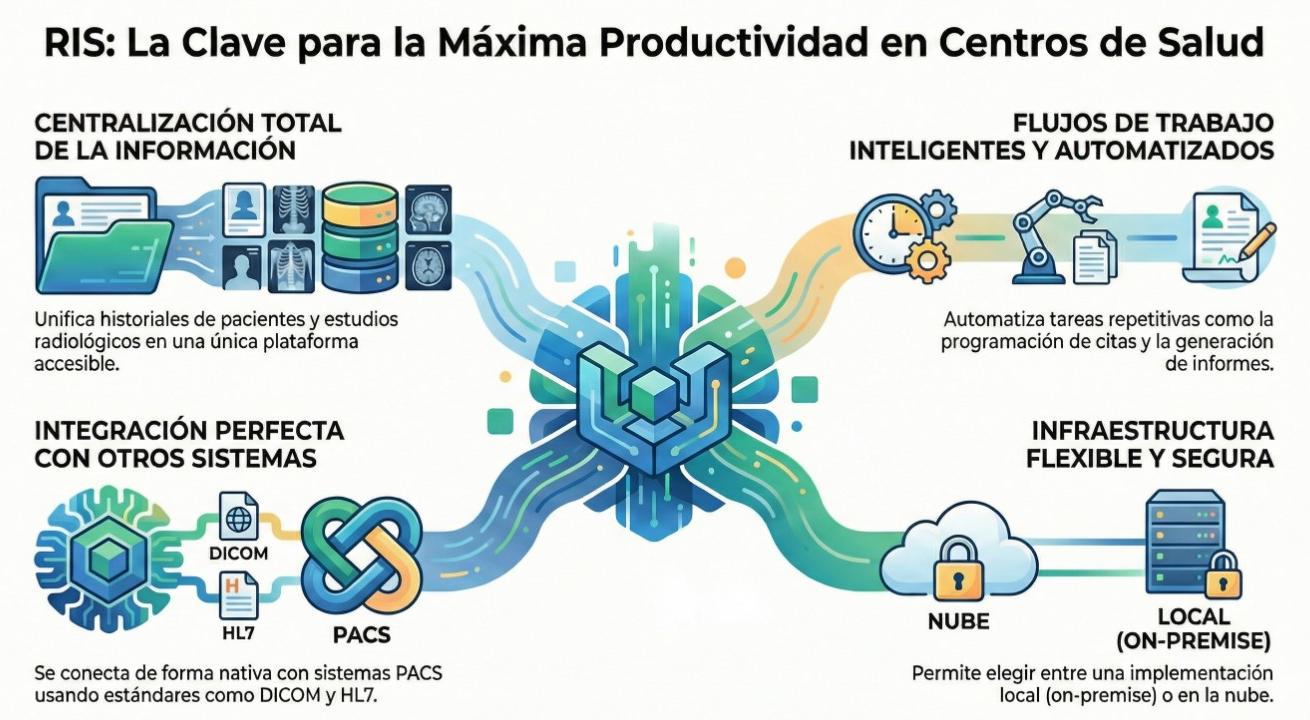
One of the biggest barriers to operational efficiency is poor communication between systems. A robust RIS is designed to provide native integration with Picture Archiving and Communication Systems (PACS) and to operate seamlessly using industry standards such as DICOM and HL7. This ensures uninterrupted data exchange across multiple platforms, eliminating duplicate information and reducing manual errors. Specialized providers like Soft in Health ensure that this systems integration operates as a unified, efficient ecosystem.
2. Optimized Data Management: Accurate Information When You Need It
With a RIS, patient information becomes centralized, organized, and instantly accessible. Medical histories, appointment schedules, and radiology exam results are all managed within a single platform. This centralized approach dramatically simplifies internal logistics, reduces patient waiting times, and ensures that clinicians always have the right information at the right time to make informed decisions.
3. Intelligent and Automated Workflows
Workflow optimization is perhaps the most immediate benefit of implementing a RIS. By automating repetitive tasks such as appointment scheduling, resource allocation, and report generation, administrative workload is significantly reduced. This allows physicians, technologists, and administrative staff to dedicate more time to high-value activities, particularly direct patient care.
4. Flexible Infrastructure: On-Premises or Cloud Deployment
Every healthcare organization has unique infrastructure requirements. Modern RIS solutions, such as those offered by Soft in Health, provide the flexibility to choose between on-premises deployment or cloud-based infrastructure (including platforms such as AWS and Huawei Cloud). This adaptability allows organizations to scale operations as demand grows, optimize infrastructure costs, and select the deployment model that best aligns with their security policies and budget.
5. Security and Regulatory Compliance
In the highly regulated healthcare industry, data security is non-negotiable. RIS platforms are built around rigorous security and confidentiality standards designed to protect sensitive patient information. By adopting digital healthcare workflows that comply with applicable regulations, healthcare organizations not only reduce regulatory risk but also strengthen patient trust.
Conclusion: A Strategic Investment in Efficiency and Quality of Care
Implementing a Radiology Information System goes far beyond technological modernization—it represents a strategic investment that transforms operational efficiency while improving the quality of healthcare delivery. By centralizing data management, automating workflows, and enabling seamless interoperability, a RIS addresses persistent challenges such as duplicate examinations, documentation errors, and information loss.
Key Takeaways
- Centralization: Consolidates patient information and imaging studies into a single platform.
- Efficiency: Automates administrative tasks, reducing patient wait times and improving resource utilization.
- Integration: Connects seamlessly with PACS and other hospital systems through standards such as HL7 and DICOM.
- Flexibility: Supports both on-premises and cloud deployments to meet the needs of any healthcare organization.
- Security: Protects sensitive patient information while ensuring compliance with healthcare regulations.
For healthcare organizations seeking not only to remain competitive but to lead in today’s digital healthcare landscape, implementing a RIS is an essential step toward a more connected and efficient future. Exploring tailored solutions such as those offered by Soft in Health enables each institution to deploy and scale a system that fits its unique operational challenges and long-term goals.