How to Calculate Medical Image Storage Costs
Boost your B2B strategy with advanced technical SEO and content marketing to improve visibility and maximize online performance.
On-Premises or Cloud? How to Optimize Medical Image Storage Costs
In the healthcare IT industry, the volume of data generated by X-rays, CT scans, and MRI studies continues to grow exponentially. For healthcare organizations, managing and storing these medical images efficiently and securely is not only an operational necessity but also a strategic priority. Understanding how to calculate the costs associated with different storage solutions is the first step toward making an informed and sustainable decision.
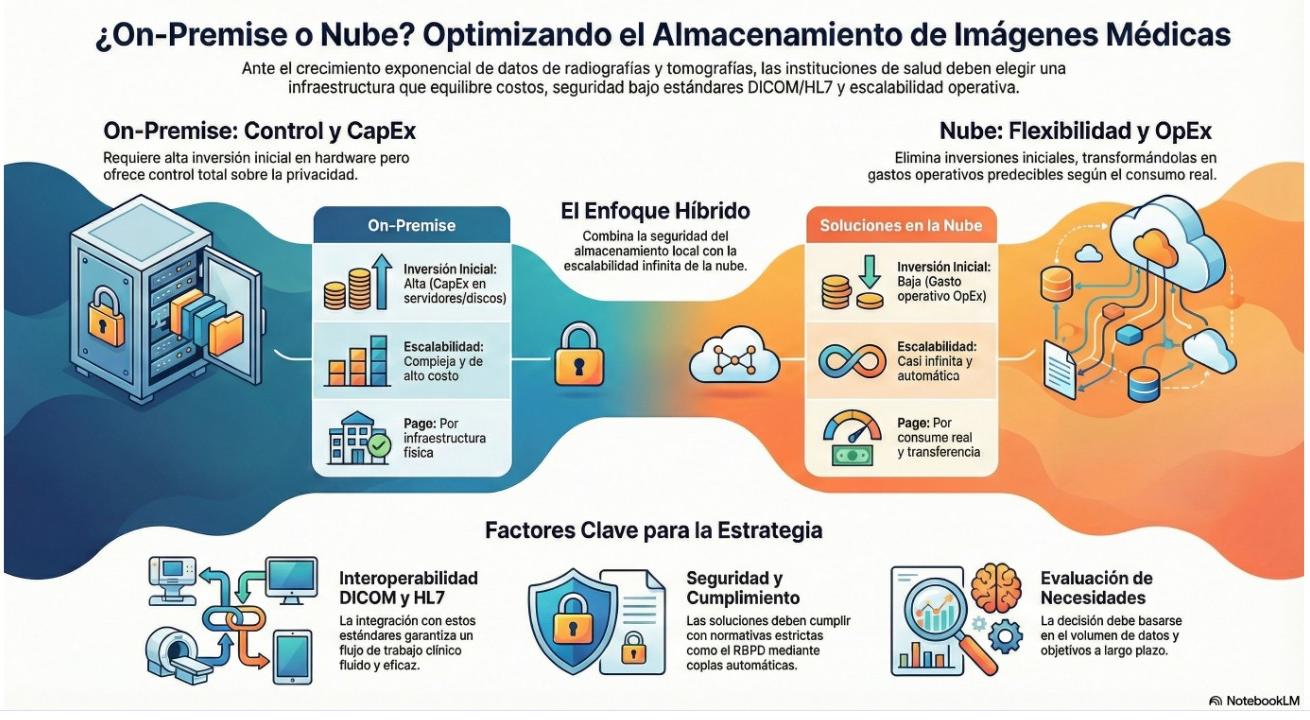
Storage Models: A Comparative Analysis
The choice of storage infrastructure directly impacts an organization’s budget, security, and scalability. Below, we examine the primary storage models implemented by Soft in Health through its RIS (Radiology Information System) and PACS (Picture Archiving and Communication System) solutions, while ensuring full compatibility with industry standards such as DICOM and HL7.
On-Premises Storage: Control and Upfront Investment
The on-premises model involves hosting the storage infrastructure within the healthcare organization’s facilities. This approach requires a significant upfront investment in servers, storage arrays, and other hardware components. In addition, organizations must account for recurring expenses such as maintenance, software and hardware upgrades, and power consumption.
The primary advantage of this model is complete control over sensitive medical data, a critical factor for organizations operating under strict privacy regulations such as the GDPR. However, scaling the infrastructure as imaging volumes increase can become both costly and operationally complex.
Cloud Storage Solutions: Flexibility and Scalability (AWS and Huawei Cloud)
Cloud-based storage solutions, including those provided by AWS and Huawei Cloud, represent a fundamental shift in infrastructure cost management. Rather than requiring substantial capital investments in hardware, cloud platforms convert capital expenditures (CapEx) into predictable operational expenses (OpEx).
Costs are primarily based on actual usage, including storage capacity consumed, data transfer volume, and access requests. Healthcare organizations pay only for the resources they use while benefiting from virtually unlimited scalability. Additionally, cloud providers deliver advanced security capabilities and automated backup services that further protect sensitive patient information.
Hybrid Infrastructure: Combining the Best of Both Worlds
For organizations seeking a balance between control and flexibility, hybrid architectures offer an excellent alternative. This approach combines the security and direct control of on-premises storage with the scalability and flexibility of cloud infrastructure. Soft in Health designs hybrid architectures that enable healthcare providers to optimize both operational efficiency and long-term storage costs according to their unique requirements.
Beyond Storage: The Importance of DICOM and HL7 Integration
Even the most efficient storage platform loses value if it is not properly integrated into the broader healthcare ecosystem. Soft in Health ensures that its RIS and PACS solutions fully comply with DICOM and HL7 standards, enabling seamless interoperability across healthcare systems. This integration supports efficient clinical workflows, improves communication between applications, and enhances overall operational performance.
Organizations beginning their digital transformation journey are encouraged to explore our digitalization solutions, which demonstrate how healthcare providers can improve patient care through technology. To learn more about achieving seamless interoperability, visit our systems integration solutions.
Conclusion: Key Considerations for a Strategic Decision
Calculating and optimizing medical image storage costs requires a comprehensive evaluation of both current and future organizational needs. Selecting the appropriate infrastructure should be based on a careful assessment of several critical factors.
- Assess Organizational Requirements: The best solution depends on imaging volume, security requirements, available budget, and long-term strategic goals.
- On-Premises Infrastructure: Provides maximum control and supports strict regulatory compliance but requires significant upfront investment and can be expensive to scale.
- Cloud Infrastructure: Offers flexible scalability and a pay-as-you-go pricing model while minimizing capital investment and reducing maintenance costs.
- Hybrid Architecture: Combines control with flexibility, delivering a balanced approach to optimizing both operational performance and infrastructure costs.
Partnering with a healthcare IT specialist such as Soft in Health is essential for navigating these decisions successfully. Our expertise helps healthcare organizations implement storage solutions that are not only cost-effective but also efficient, scalable, and aligned with international best practices. By selecting the right infrastructure, organizations can focus on their primary mission: delivering high-quality patient care.
To learn more about our medical imaging management solutions, explore our NEXtris platform.